
The Season of Advent: Approaching Joy
Rev. Lori’s sermon from Sunday, November 30th, 2025

There is a moment in the early morning—just before sunrise—when the sky holds its breath. The darkness hasn’t lifted yet, but something in the air has changed. The light you cannot yet see is already touching the edges of the day. It is a moment of anticipation… of leaning forward… of sensing that the world is becoming something just a little more whole. I don’t often see this moment, as I am not a morning person. But I am told this is so.
This moment, I think, is the season of Advent.
Some of us did not grow up with Advent, or if we did, it may have been wrapped in traditions that don’t entirely fit who we are now. But here in a Unitarian Universalist sanctuary, Advent becomes something beautifully spacious. It becomes a time not of dogma, but of spiritual practice—a time to remember that transformation, personal and collective, begins before the moment of birth. It begins in the waiting, in the watching, in the deep and ancient human instinct to look toward the coming of light.
Today we focus on one movement within that season: Approaching Joy.
Not joy triumphant.
Not unshakeable joy.
But a joy we are moving toward—tentatively, courageously, honestly.
And maybe that’s the most faithful way to speak of joy in a world like ours.
Advent is often described as a season of waiting, and waiting is not something our culture does very well. We want results, answers, clarity, resolution—preferably yesterday. But Advent invites us to a countercultural truth: that there is wisdom in the in-between places, in the not-yet, in the quiet spaces where new life is still forming.
For Unitarian Universalists, Advent is not limited to preparing for one birth long ago. It is a season that asks us to pay attention to what is trying to be born here and now. What new courage? What new kindness? What new justice? What new joy?
The poet Jan Richardson writes, “Light knows how to wait.”
And so must we.

Advent teaches that light does not arrive fully formed. First comes the softening of the horizon, the flicker of a candle, the warmth of a single act of love. And that is where our story of joy begins.
Let’s be honest: joy can feel complicated right now.
The world holds so much pain—violence, division, fear, fatigue. Our own lives hold so much uncertainty—grief, illness, financial worries, relationship strain, the quiet ache of loneliness. It can feel like an extravagance to speak of joy. Maybe even irresponsible.
And yet joy insists on showing up anyway.
Joy is not a dismissal of reality. Joy is a defiant, life-affirming whisper that reality is not finished with us yet.
Joy doesn’t say, “Everything is fine.” It says, “There is still beauty. There is still connection. There is still possibility. Do not close your eyes.”
Approaching joy means allowing ourselves to move toward those moments of truth without pretending that pain does not exist.
One of the great spiritual paradoxes is that joy and sorrow travel together. We feel joy most deeply when we do not deny sorrow, but hold it tenderly. Joy is not the opposite of sorrow; joy is what rises when love has its way even in the midst of sorrow.
Advent reminds us that joy is always born in a world that needs healing.
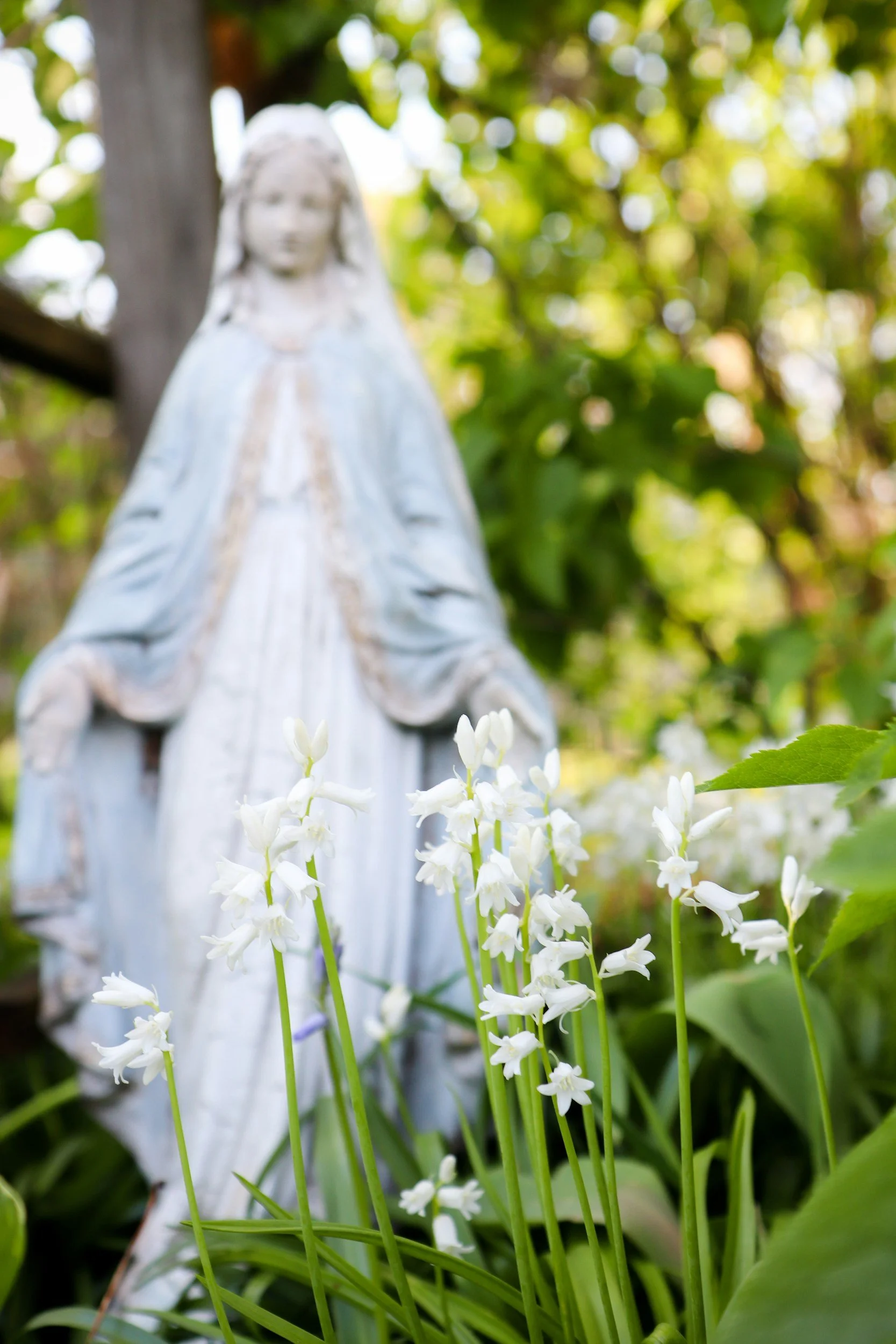
This is one reason the story of Mary—whatever you believe about its details—still speaks across time. Mary receives news that her life is about to change in ways she cannot fully understand. She is young, vulnerable, uncertain. And yet she responds with a kind of courage that is quiet but resolute. She says yes to something larger than herself.
And then, according to the Gospel of Luke, she sings.
It is not a song of triumph; it is a song of radical hope, a song that imagines a world made more just, more loving, more whole. Her joy does not come because everything is clear or easy. Her joy comes because she senses that the Holy—however we name it—is moving in her life and in the world.
Our tradition teaches that Mary’s song is not just an ancient tale; it is a reminder that joy is born in ordinary people, in uncertain circumstances, with no guarantee of the ending.
We are all Mary in some way. We all carry something that wants to be born—
an act of courage,
a reconciliation long avoided,
a calling we have resisted,
a truth we have been afraid to name,
a dream we have kept tucked away.
Approaching joy means paying attention to what is gestating inside us.
Another truth about joy: it is rarely a solo endeavor. We need one another to approach joy. Joy is braided through community.
Think about the last time you felt genuine joy.
Maybe it was around a table, laughing with people you love.
Maybe it was when someone showed up for you unexpectedly.
Maybe it was watching a child discover something new.
Maybe it was the sudden gratitude that washed over you when someone offered a kindness at exactly the right moment.
These moments are not isolated; they arise from connection.
Joy is the spark that leaps between souls.
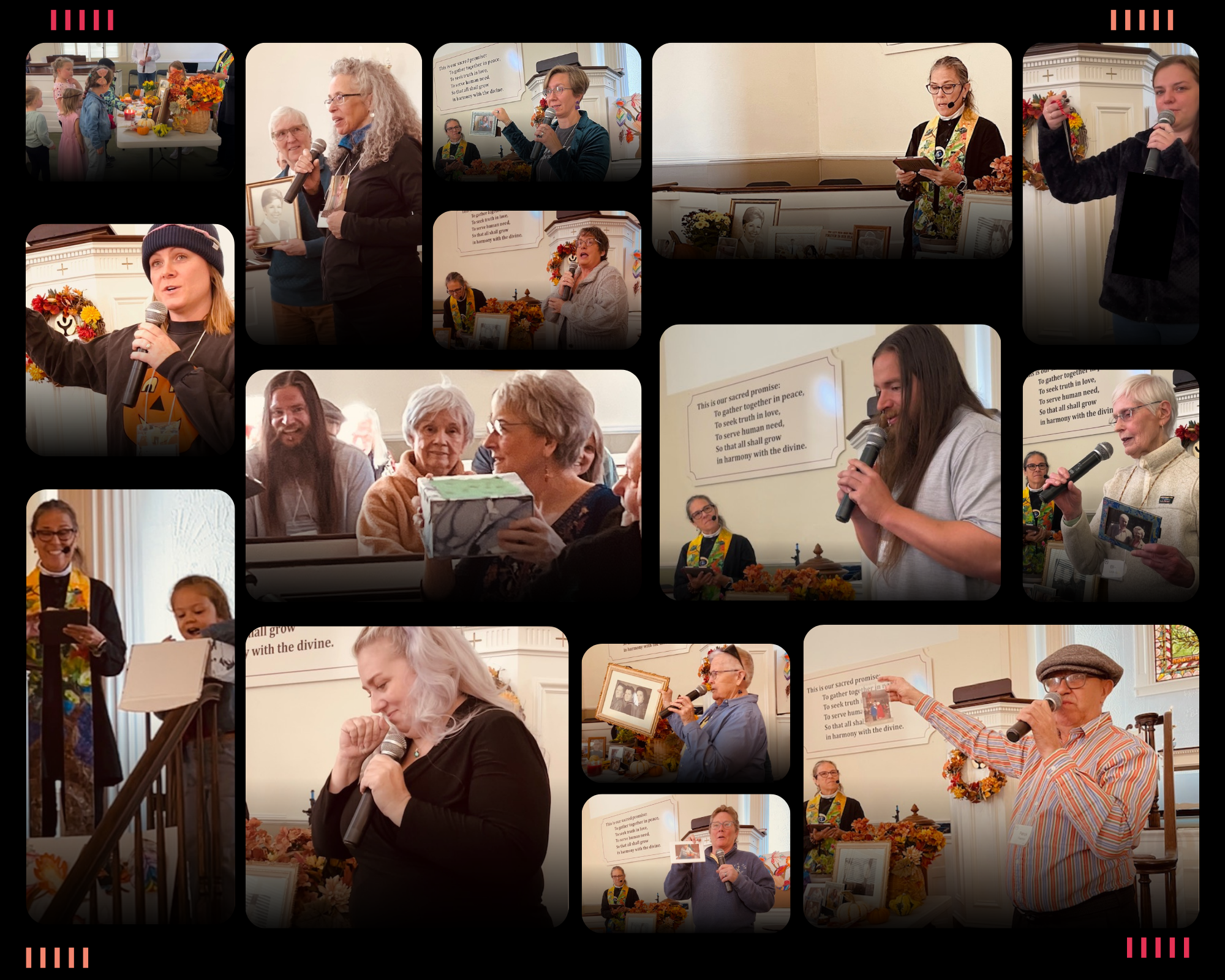
UUCSB Samhain Service 2025
This is why we come to church—not just for comfort or inspiration, though those are welcome, but because joy is something we practice together. When we sing together, when we sit in silence together, when we hold one another’s grief and celebrate one another’s milestones, we create room for joy to grow.
Here in this community, joy is not fragile. It is resilient. It knows how to live alongside sorrow. It knows how to wait. And it knows how to return.
One of the most powerful things we can remember is that joy is not just an emotion—it is an act of resistance.
To feel joy in a world that profits from fear is a radical act. To nurture joy in a time of cynicism is a revolutionary practice. To protect the joy of children, of elders, of the marginalized is to say that life is sacred.
Joy expands our capacity to keep going. Not by denying the struggle, but by reminding us what the struggle is for.
Audre Lorde wrote, “The sharing of joy forms a bridge between the present and the future.”

That is Advent. A bridge between the world as it is and the world as it could be. A bridge built one small flame, one small act of love, one small step toward joy at a time.
So how do we do it? How do we approach joy when life feels heavy?
I want to offer three practices—simple, but not easy:
Advent teaches us that joy begins small. A moment of warm sunlight. A deep breath. A shared smile. A memory that returns with tenderness instead of pain. These small joys are the seedlings of a larger joy that can sustain us.
This may be the hardest of all. Many of us are far more comfortable giving than receiving. But joy requires openness. It requires the willingness to be vulnerable—to accept help, to accept love, to accept that we, too, deserve delight.
Joy is amplified when it is shared. Light your candles at home, yes, but come here and sing with others. Show up for someone else’s celebration. Let others show up for yours. Joy widens when we offer it to one another.
There is a line in the Advent hymn “People Look East”: “Make your house fair as you are able; trim the hearth and set the table.”

It is an invitation to prepare—not out of anxiety, but out of hospitality for the joy that is on its way.
Maybe joy is not something we find. Maybe joy is something we prepare for.
We set our table with compassion. We trim our hearth with gratitude. We make our house fair with justice, with integrity, with the courage to love boldly.
And in that prepared space, joy finds room to enter.
One of the deepest gifts of Advent is the reminder that joy is not just personal—it is collective. Our world is in desperate need of communities that choose joy not as escapism, but as ethical practice.
A joyful community is one that:
cherishes every person’s dignity,
resists despair by acting for justice,
cares for the vulnerable,
celebrates each small victory for peace,
and believes—stubbornly, resiliently—that the arc of the universe bends toward more light.
If joy is approaching, it is approaching through us.
Through the ways we show up for each other. Through the ways we repair what is broken. Through the ways our love takes form in the world.
Imagine again that pre-dawn moment when the sky hasn’t brightened yet. Imagine standing in that liminal stillness with others—friends, family, strangers—each of you holding a lantern. Your lantern alone cannot overcome the darkness, but together, a glow begins to rise.

This is Advent. This is approaching joy. The light we carry is not yet the sunrise, but it is enough to move us toward the day.
And so in this season, may we keep walking—lanterns lifted, hearts open, steps steady.
May we prepare a place within ourselves for the joy that is quietly drawing near.
May we trust that joy is not a luxury but a lifeline, not a distraction but a compass, not a fleeting feeling but a force that calls us toward wholeness.
And may we remember this truth: In every season—even this one—joy is approaching. And we are approaching it. Together.
Amen. Blessed be. And may it be so.